
Clontarf is tiny, beautiful and hard to get to. It sits on Middle Harbour just north of the Spit Bridge, wrapped around a netted beach and a reserve, backed by steep bushland streets, with the Sydney Harbour National Park at its edge and a walking track to the Grotto Point lighthouse.
That setting makes a clontarf florist’s job specific: waterfront event work, arrangements that survive salt and breeze, and deliveries into streets that a courier from anywhere else will not find. Here is how to buy well in 2093.
Why Local Knowledge Is Essential
- The Spit Bridge is the gate. When it lifts for boat traffic, or when weekend traffic backs up along Spit Road, every delivery window in the suburb moves. This is the single biggest logistical factor in Clontarf.
- The streets above the beach are steep and narrow, with several addresses reached by stairs from the road above.
- Sandy Bay Road and Clontarf Street are the spines, and everything branches off them into short dead ends.
- Houses are set into the slope and screened by bushland, so numbers are frequently invisible.
- Clontarf Reserve and the beach car park fill completely on any warm weekend.
- Clontarf, Balgowlah Heights and Seaforth blur together on maps and in conversation.
A clontarf florist based locally plans around the bridge and knows which streets end in stairs. A national ordergatherer does not – it keeps a margin and hands a reduced brief to whoever accepts it.
Delivery Coverage
Immediate: Clontarf, Balgowlah Heights, Balgowlah, Seaforth, Manly, Fairlight, Little Manly, North Balgowlah.
Comfortable same-day: Mosman, Balmoral, Beauty Point, Clifton Gardens, Cremorne, Neutral Bay, Freshwater, Queenscliff, Curl Curl.
Same-day with earlier cut-off: North Sydney, Kirribilli, Milsons Point, Cammeray, Northbridge, Castlecrag, Willoughby, Chatswood, Dee Why.
Typical same-day cut-off is around 11am to noon weekdays, earlier in peak summer, and roughly 10am on Saturday. Ask about the bridge before you commit to a window.
Watch: How a Wedding Buttonhole Is Really Made
Clontarf is a wedding suburb, and buttonholes are the item most often left to the last minute. This is a full startto-finish build for a real wedding: I Made This Boutonniere For A Real Wedding.
The technique matters here more than most places. Wired and taped buttonholes hold up through a windy waterfront ceremony and a long reception; hot-glued ones fall apart by the second dance.
Beach and Waterfront Weddings
Clontarf Reserve and beach is one of the most-booked ceremony locations on Middle Harbour, and the flowers have to be engineered rather than merely designed.
Wind is the primary constraint. Breeze funnels up Middle Harbour from mid-morning and is consistently stronger than couples expect. Practically:
- Weight everything above waist height – sandbags, water bases, or ground anchors where permitted.
- Compact, dense designs hold. Loose, airy ones shred.
- Bind bouquets tightly rather than loosely hand-tying them.
- Choose firm-petalled stems – protea, leucadendron, orchid, waratah, anthurium, banksia. Skip sweet pea, hydrangea and delicate garden roses.
- Use dried and preserved elements. Wind-proof, heat-proof, and they become a keepsake. A 30 percent dried blend is a genuinely smart Clontarf strategy.
- Secure buttonholes with two pins, not one.
Sand and access: ceremony spots on the beach mean carrying everything from the car park, which is often full. Tell your clontarf florist the exact distance and the likely parking situation – it changes the crew size.
Permits: ceremonies on the beach and in the reserve require council approval, with conditions on structures, pegs, adhesives, numbers and pack-down times. The beach, reserve and event permit information sets out what is allowed where. Get it before your florist quotes, because it will determine your arbour design entirely.
Popular local ceremony spots: Clontarf Reserve and beach, the Grotto Point track lookouts, Castle Rock beach, Sandy Bay, and a solid volume of at-home weddings in the waterfront properties.
The Salt and Sun Problem
Clontarf is a genuine test for cut flowers. Three factors work against vase life: salt aerosol carried inland on the breeze, hard sun on both the east and west aspects, and summer humidity accelerating bacteria in vase water.
Research on coastal exposure, salt aerosol travel and plant tolerance through coastal and environmental science research documents how far salt spray reaches inland and what it does to foliage. The practical lesson is straightforward.
Excellent in Clontarf:
- Protea and leucadendron – waxy, thick-petalled, two to three weeks
- Banksia – almost indestructible, and dries beautifully afterwards
- Waratah and kangaroo paw – structural and heat-tolerant
- Orchid (cymbidium, dendrobium, phalaenopsis) – superb humidity tolerance
- Anthurium – glossy and modern, holds indefinitely
- Chrysanthemum in modern antique tones
- Gum, olive and pistachio foliage
Riskier near the water: hydrangea, sweet pea, ranunculus, gardenia, anemone, delicate garden roses. Fine indoors in a cool room, short-lived on a terrace.
Seasonal Guide
Spring (Sep-Nov): ranunculus, tulip, stock, sweet pea, garden roses, blossom branches. Best value quarter of the year – keep the delicate stems indoors.
Summer (Dec-Feb): orchid, anthurium, protea, agapanthus, frangipani, gladioli. This is when native and waxypetalled stems earn their keep.
Autumn (Mar-May): chrysanthemum, dahlia, protea, banksia, celosia, berried and rust-toned foliage. Excellent value and vase life.
Winter (Jun-Aug): waratah, wattle, anemone, hellebore, magnolia branch, camellia. Winter is the coast’s kindest season.
What Clontarf Buys Flowers For
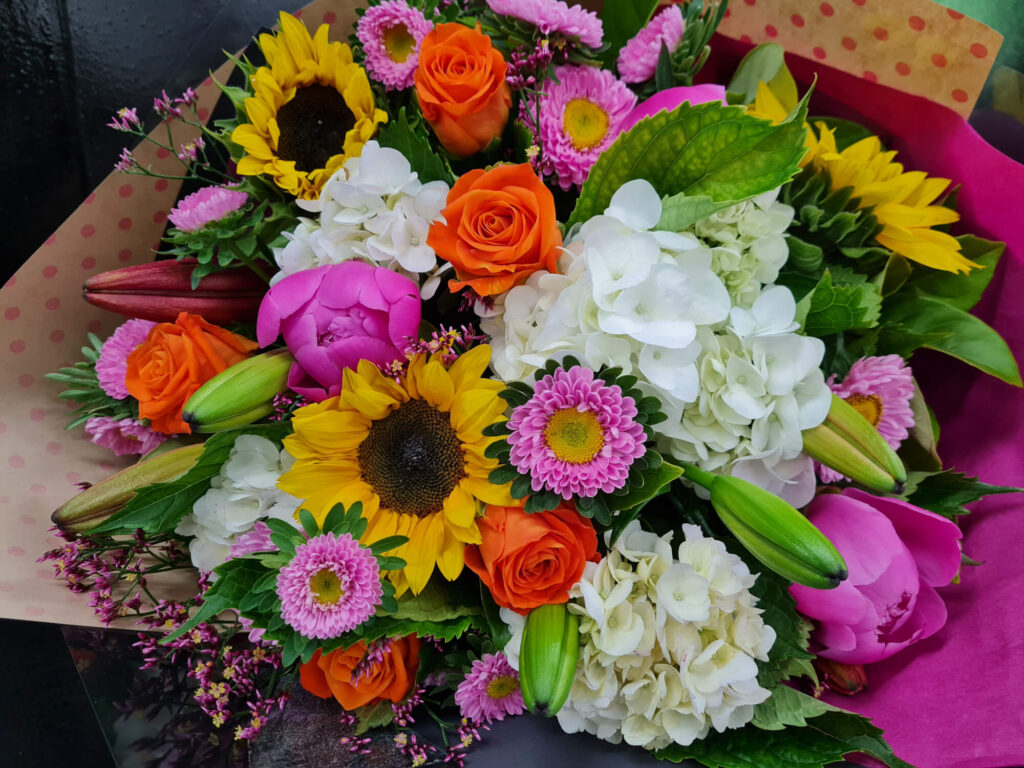
- Beach weddings and elopements at Clontarf Reserve, peaking October to April
- Native and dried arrangements for coastal-styled homes
- Weekly standing home orders
- Low dining arrangements that preserve the Middle Harbour view
- Sailing and boating club presentations
- Birthday and thank you bouquets, often delivered while people are at the beach
- Sympathy tributes to homes and Northern Beaches funeral homes
- Picnic and proposal bouquets for the beach and the Grotto Point track
Making Them Last on the Water
- Keep arrangements inside, away from open doors and salt-carrying breeze.
- Out of direct sun, morning and afternoon.
- Recut stems 2cm at 45 degrees every second day.
- Change the water completely rather than topping up – humidity accelerates bacteria.
- Use the flower food sachet.
- Never place a vase near a fruit bowl.
- Move arrangements to a cooler room overnight in summer.
- For anything unattended, choose banksia, protea, orchid or anthurium.
Seven Questions Before You Order
- Where is your workroom, physically?
- What is the genuine same-day cut-off, and how do you allow for the Spit Bridge?
- Which blooms do you recommend for a waterfront terrace?
- For a ceremony at Clontarf Reserve, how do you weight installations?
- Do you work with dried and preserved elements? 6. Do you wire and tape buttonholes, or glue them?
7. What happens if the address is up a flight of stairs and nobody is home?
The Bottom Line
A good clontarf florist designs for salt, sun and Middle Harbour breeze: protea, banksia, waratah, orchid and dried elements over soft-petalled blooms, tightly bound bouquets, properly wired buttonholes, and installations weighted for wind. Order inside the cut-off, allow for the bridge, keep vases away from open doors, and lean into natives. That is how a clontarf florist delivers flowers that last as long here as anywhere in Sydney.